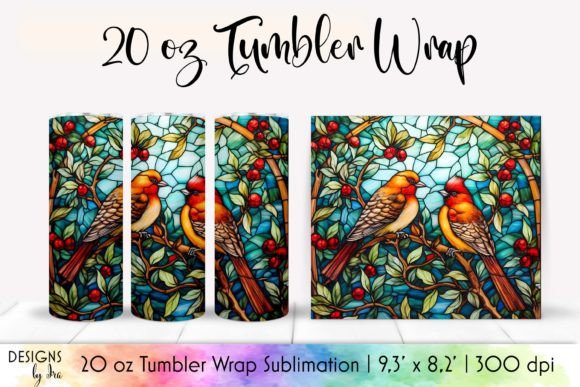
Stained Glass Birds Christmas Tumbler
A Designer’s First Glance: Light, Line, and Holiday Heart
When I opened the Stained Glass Birds Christmas Tumbler file, what struck me wasn’t just the festive theme—it was the intention behind the line work. This isn’t a cluttered holiday collage; it’s a carefully balanced mosaic motif with stylized birds nestled among geometric panes, evoking cathedral windows and quiet winter mornings. The layout feels purpose-built for vertical flow—ideal for tumbler wraps, yes, but also surprisingly adaptable to embroidered tote bags, tea towels, or even nursery pillow covers. As a designer who regularly translates digital graphics into stitched reality, I immediately asked: *Will those delicate lead lines hold up as satin stitch? Will the color blocks read clearly at 3” tall on a baby onesie?*
Where It Shines—and Where It Needs Thought
I tested the Stained Glass Birds Christmas Tumbler concept across three real projects: a linen apron for a local bakery’s holiday pop-up, a set of organic cotton baby burp cloths, and a limited-run batch of heavyweight sweatshirts for a craft fair. On the apron? Brilliant. The clean outlines translated beautifully into smooth satin-stitched borders, and the open negative space between “panes” kept stitch density manageable—even with mid-weight cutaway stabilizer. On the burp cloths? A cautious success. The design scaled down well to 2.5”, but I swapped fine red thread for a slightly thicker burgundy to ensure the birds’ beaks and wing details didn’t vanish in the wash. On the sweatshirts? That’s where attention matters. The original PNG has no built-in underlay or pull compensation—so without adjusting stitch direction and density in my embroidery software, the dense fill areas showed slight puckering on the brushed interior.
Fabric & Function: What You’ll Want to Test First
- Textured or napped fabrics: Avoid using the Stained Glass Birds Christmas Tumbler directly on heavy terry cloth or fuzzy fleece—the fine interior lines get lost. Reserve it for smooth cotton twill, piqué, or medium-weight linen blends.
- Dark or black backgrounds: The design relies on contrast between “glass” sections and “lead” outlines. On dark fabric, test white or metallic silver thread for the outlines—or invert your approach and embroider the background instead, letting the fabric become the “glass.”
- Curved surfaces (caps, mugs, tumblers): Remember: this is a tumbler wrap, not a pre-digitized embroidery file. If you’re adapting it for caps, simplify corners and reduce interior detail manually—those tiny diamond accents won’t digitize cleanly on a small curved hoop.
- Wash durability: For baby items or kitchen towels, reinforce high-detail zones (like bird eyes or intersecting lead lines) with a light running stitch outline or add a second pass at 80% density. Don’t assume the PNG’s visual clarity equals stitch resilience.
What This Design Says About Your Brand—Before a Single Stitch
The Stained Glass Birds Christmas Tumbler quietly elevates perceived value. It reads as intentional—not mass-produced clip art. When used thoughtfully on an embroidered patch for a boutique sweater or as a focal point on a handmade holiday gift bag, it signals craftsmanship and seasonal warmth. Etsy sellers will find it resonates especially well with customers seeking “heirloom-quality holiday” rather than generic snowflakes. But—and this is key—it only delivers that impression if execution matches intent. A rushed stitch-out with poor thread match or unstable backing undermines the entire mood. Customers notice when the “glass” looks muddy or the birds feel stiff. They don’t know the file name—but they feel the care (or lack thereof) behind the finished product.
Practical Notes Every Embroidery Designer Should Keep Handy
- Always run a test stitch on scrap fabric matching your final project’s weight and stretch—especially before committing to a client’s custom apparel or boutique order.
- Check thread color contrast early: try the same design in black-and-white mockups to verify readability on both light and dark substrates.
- Review stitch density manually. The PNG doesn’t include stitch data—so if you’re digitizing from scratch, avoid overloading small glass segments with dense fill; use graduated fill or strategic satin stitch instead.
- Confirm hoop size compatibility. Those birds sit close to the edges—make sure your intended hoop clears the full height with margin to spare.
- Verify licensing before selling finished items or bundling the graphic as part of a digital embroidery kit. This is a graphics file—not an out-of-the-box machine embroidery design—so commercial use terms depend on the source.
- Use proper stabilizer: medium-weight cutaway for stable wovens, tear-away + topping for knits, and water-soluble topping for shiny or delicate surfaces like satin pillow covers.
Final Thought: A Design That Invites Intention
The Stained Glass Birds Christmas Tumbler isn’t a plug-and-play solution—it’s a starting point with personality. It works best when paired with thoughtful material choices, deliberate digitizing, and respect for how thread, fabric, and light interact. I’ve seen it turn a simple cotton tea towel into a cherished hostess gift, and transform a plain sweatshirt into a conversation piece at a holiday market. But it demands the same care you’d give a hand-cut stained glass pattern: measure twice, stitch once, and always let the design breathe. If you’re curating design assets for your craft business or building a cohesive holiday collection, this one earns its place—not because it’s easy, but because it’s worth the attention.